
Our hip joints are large weight-bearing joints that connect our legs to our pelvis.
By: Rebekah Hobbs
Along with the pelvis they provide a stable point from which we can move our legs (walking or running), move our bodies (twisting, bending forward and leaning backwards) and allow us to have a base of support in a sitting position.
The hip can be considered as a very stable joint, but can be injured if the surrounding muscles are not functioning correctly or from trauma- be it internal or external.
- When there is injury or dysfunction at the hip joint, simple daily activities such as sitting down and standing up, walking, running and climbing stairs become harder or even impossible to do.
- Higher functioning activities such as: dancing, soccer, hockey, athletic events, gymnastics and gym-based training will also be affected.
The main functions of the hip are to distribute the weight of the head, arms and trunk from the pelvis equally to each leg and thereafter, the floor and provide a wide range of motion to allow locomotion (moving the body from one place to another) in different environments.
The hip joint is often compared to the shoulder joint for 4 reasons:
- They are both ball and socket joints.
- They are both triaxial (having three planes of movement).
- They are both the most proximal (closest to the body) connection of our limb to our bodies.
- They both aim to give maximum stability and mobility to the limb they service.
However, while the shoulder compromises on stability to allow greater mobility the hip compromises on mobility to provide the stability needed to bear the weight of the body.
Bones
The hip joint is made up of two bones, the femur or thigh bone and the pelvic bone/pelvis. The pelvic bone is a fusion of three bones that happens as our bones grow and mature. These bones are the ilium (two fifths), ischium (two fifths) and pubis (one fifth). These bones themselves have important functions individually outside of the hip joint’s function. However, where they all join they form the acetabulum. The acetabulum is the socket portion of the hip joint, while the femoral head is the ball forming the ball-and-socket joint. Important joints closely associated with the hip joint biomechanically are the sacroiliac joints (SIJ), pubic symphysis (that joins the pelvis in front) and the knee joints.

Cartilage
Along with the bones, the equally important cartilage needs to be mentioned. There are three main pieces of cartilage in the joint; the labrum which extends from the cartilage lining the acetabulum around the rim and the cartilage lining the femoral head. The labrum protrudes from the rim of the acetabulum to increase the depth of the socket, providing extra stability to the femoral head.
The cartilage acts as a cover over the bones, to enable them to move easier in the joint capsule and glide in relation to each other. Without the cartilage – movement would be much harder. This is also the first part that gets affected with degeneration and osteoarthritis.

Ligaments
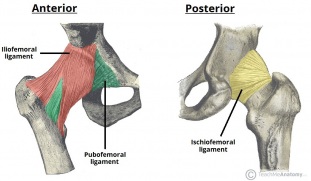
The powerful but flexible joint capsule is made up of three major ligaments that extend from each section of the pelvic bone. These ligaments are the most direct force holding the femoral head in the acetabulum. They are the iliofemoral, ischiofemoral and pubofemoral ligaments. Inside the joint capsule, there is another ligament – the ligametum teres – which protects the artery supplying blood to the head of the femur. Outside the joint capsule, another ligament – the transverse acetabular ligament – provides an extra support at the base of the joint.
There is a capsule around the joint, that originates from the ligaments. Which contains synovial fluid, that acts as a lubricant to allow the joint to move smooth. This capsule is a very strong structure and adds greatly to the stability of the hip (unlike the shoulder – where it lacks stability). The capsule is thicker and stronger in the anteriosuperior angle where the predominant weight bearing occurs.

Muscles and Movement
There are many muscles and large muscle groups that act on the hip joint to perform these movements.
The hip is able to move in 6 directions or degrees of motion:
- Flexion Muscles – Iliopsoas, Sartorius, Rectus Femoris and Tensor Fascia Latae (TFL)
- Extension Muscles – Gluteus Maximus, Bicpes Femoris, Semimembranosus
- Abduction Muscles – Piriformis, Gluteus Medius and Minimus
- Adduction Muscles – Adductors Longus, Brevis and Magnus along with Quadratus Femoris, Gracilis and Pectineus
- Internal Rotation Muscles – Gluteus Medius, Minimus and Adductor Magnus
- External Rotation Muscles – Obturator Internus & Externus, Superior & Inferior Gemellus Muscle, Quadratus Femoris and Piriformis.
When movement occurs at the hip there is a ‘give and take’ motion between the hip and pelvis. In a closed-chain movement (foot or knee is stabilised on a surface and the movement is classified as being closed because it is ‘anchored’), the pelvic bone moves while the femur is stationary. In an open-chain movement (leg is not on a surface and moves freely in space this movement is open because it is not anchored), the femur moves while the pelvic bone is stationary. The pelvis is stabilised by the abdominal canister (part of which was previously referred to as the core muscles). The abdominal canister consists of the pelvic floor muscles, Transversus abdominus (part of your abs) and Multifidus (part of the back muscles). These muscles prevent excessive movement of the pelvis with hip motion while maintaining good alignment of the spine and trunk.
Hip Injuries
Injuries to the hip can occur at many structures and by many different mechanisms or movements. Some populations are more vulnerable to certain injuries than others. For example, older adults are more prone to hip fractures; and certain sports make you prone to various hip injuries because of the repetitive nature of certain movements and sudden directional changes.
Some common hip injuries are:
- Labral Tears are usually caused by acute trauma or repetitive stress. They consist of a partial or full tear of a piece of the labrum, which can then cause locking or catching and pain in the hip joint.
- Bursitis is an inflammation of a bursa. A bursa is a fluid-filled sac that provides cushioning and prevents friction between soft tissue and bones. The most common bursa to get inflamed in the hip is the Greater Trochanteric bursa on the outside of the hip, but Iliopsoas bursitis on the inside of the hip is also possible. The most common symptom is pain directly on the side of the hip.
- Femoroacetabular or Hip Impingement occurs when either the head of the femur or acetabulum becomes deformed while growing. This causes a restriction and grinding of the bone with wide range movements of the hip. Some groin pain and ‘catching’ of certain movements might occur, loss of range of motion can also occur in the hip.
- Fractures of the hip can form at many sites. Trauma from a fall or motor vehicle accident can cause a fracture. Older people and people with osteopenia or osteoporosis are prone to hip fractures with lighter trauma such as a fall. Hip fractures are divided into two main types; intracapsular (in the hip capsule) or extracapsule (outside the hip capsule). Intracapsular fractures are more serious than extracapsular ones.
- Avulsion fractures: this is common in trauma type injuries and occurs when the tendon pulls so hard on the bone, that a piece of the bone fractures off. This can occur in a few different sites of the hip.
- Tendinopathy or tendon injuries: A tendinopathy is when a tendon becomes inflamed and swollen due to excessive load, if it is not treated it can start to degenerate and tear. The Iliopsoas tendon is the most common tendon to develop a tendinopathy. It can make a snapping sound and is called Snapping Hip. The adductor tendons are also prone to tendinopathy.
- Arthritis of the hip is when there is inflammation in femoroacetabular joint (the ball and socket joint). The inflammation can be caused by excessive strain over years or by an inflammatory condition. The most common types of arthritis are osteoarthritis and rheumatoid arthritis.
The significance of the HIP
Our hips are one of the largest joints in our bodies and for good reason. Our hips allow us to propel ourselves forward in running, sprinting and jumping or simply rising from a chair. They allow us to get in and out of the car or dance anything from a sokkie to hip-hop or ballet. Injuries to the hip can be very debilitating, so we need to ensure our hips are properly strengthened and have good flexibility.
If you have hip pain don’t leave it too long without seeking an assessment or advice.